

I wrote on my return from hiatus a few weeks ago that I would maintain a new, biweekly publishing schedule. That is my long-term intention. But I neglected to consider when I made that determination the upcoming midterm elections in the United States.
It was just over two years ago, in July 2024, that I started American Samizdat as a second publishing platform for myself on Substack, its motto, as it states above, “to warn against, prepare for, and persevere until.” I did what I could, wrote what I could, to prevent what happened. We all failed, those of us who cared. We failed.
Subscribers who read me on Substack Notes know more immediately that I am deeply pessimistic about the future in the U.S. (of the world, frankly). That isn’t a matter of temperament but of clear-eyed reading of the present and the past. I avoid what too many succumb to, what’s come to be called “hopium.” — You get it. Many are addicted to it. But hopium, like other addictive sedatives, produces quiescence, a twilight daydream when, to the contrary, doors need to be broken down. American Samizdat continues to serve as a wakeup call.
I regret to say that over ten years, nothing I have predicted since I first wrote to oppose Donald Trump in 2016, and ever since, has proven wrong. After the November 2024 presidential election outcome, I published,

I wrote then that Trump’s electoral victory at that time, after all we knew, was, irrevocably, the end of the United States that was founded in 1776. It was. An “America” that is somehow rescued from the MAGA brutalitarianism Trump called up from the national basement, but that is not re-founded, will not be the same America. An actually re-founded America will be, must be, a second republic.
The upcoming midterm elections, just 3 months away, are critical to any potential re-founding, in my lifetime anyway. How young are you? But to be clear, I’m not simply talking about a “blue wave.” For this is what I and many others see coming.
If you follow events closely enough, you know (and if you don’t, you sadly don’t know) that the Trump regime has been hard at work, from the day it regained power, corrupting the U.S. electoral system. I won’t detail the many ways. You can turn to journalism for that. The regime has been doing that precisely to prepare for this upcoming election.
This is a regime firmly committed to brutalitarian tyranny. Donald Trump has already tried violently to overthrow the American democratic system. If the United States were still operating under any kind of effective political order and rule of law, he would be in prison now for that and for many other crimes. He is not in prison. He stands, instead, colossally dysfunctional yet powerful over the nation and the world, and neither he nor any of the reactionary forces in the United States behind him worked for decades to achieve this power, have not behaved the way they have behaved, only to cede that power in the end because of an election outcome. Brutalitarian tyrants do no respect elections.
Even if there is some level of blue wave, the GOP will contest critical elections results. They will file lawsuits and appeals. They will claim that outcomes are undetermined. They will extend controversy and confusion as long as possible to January 2, 2027 and beyond and argue against giving up congressional offices (literally and figuratively) when outcomes are still in doubt. All depending on the nature and intensity of a democratic response, including in the streets, Trump will declare some level of emergency, even to the point of martial law. The more dramatic even a nonviolent civil disobedient reaction may be, the more Trump will distort its meaning as rationale for further repression and suspension of democratic governance.
This is not my or anyone’s imagination at work. This is history. This is how it is always done. The MAGA brutalitarians never thought it was over after November 2026. They knew more was needed to solidify permanent power. They have been preparing for this election all along. After it, if they succeed, any dreams you may have had about a 2028 presidential election will be reduced to that fantasy fiction entirely.
So let’s say that massive blue wave we dream of does sweep over the land. And let’s say, nonetheless, what I predict will happen happens.
What will you do? What are you prepared to do? Will you stop living normally or will you just accept it?
Between now and election day 2026, I have time for 8 selections from American Samizdat essays I published after the 2024 presidential election. These are essays in which I try to communicate my insights into what is happening, both in the United States particularly and in the world at large. The following, slightly revised to fit the time and circumstances, first appeared November 23, 2024.
*All emphasis below is mine.
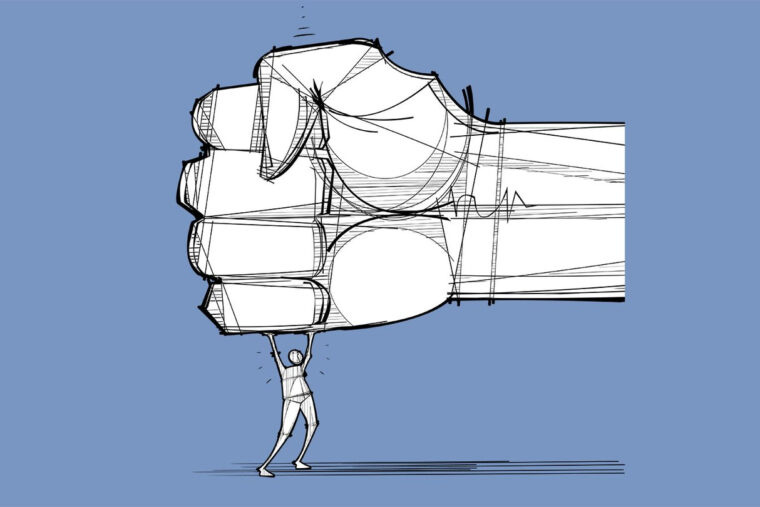
The purpose of a good, well-applied analogy is to elucidate. The purpose of a good analogy is not to claim that one thing is identical to another — without identifiable difference. That is never the case. The vocabulary of autocracy, however, the vicious and violent vernacular of the passion-inflaming demagogue, arises from a language that lives across time, space, and history. Our task — to hear its rumble amid the din of the everyday babel.
In truth, far from the dismissive, even derisive denials of those always reluctant to stake a bold claim in the open field of the present in order to foresee the future’s terrain, analogies of Donald Trump to Adolf Hitler are probably the closest and most useful of any to be offered between Trump and the many tyrants of the past one hundred years.
Those of moderate temperament will (they will, still, after all that has happened) snort with patronizing gaze down over the pinched lenses of an analytical pince-nez that one loses all credibility with such “hysteria.” Trump is not another Hitler, they will say. Nazism, world conquest, the Holocaust were incomparable world-historic events — one of a kind, a perfect storm, the GOAT of calamities, we will not see they’re like again; Hitler doubled down on a rising tide, it can’t happen here, the institutions are too strong, Americans are a good people. The cliches tumble into view like great skeletal balls of weed whisking over the streets of a thinking person’s ghost town. Germans thought they were a great people, too.
The [Philadelphia] Evening Bulletin, January 30, 1933
Hitler Selected as Chancellor in Divided Cabinet
Adolf Hitler today was named Chancellor of Germany and the Republic has entered upon an adventure whose ending cannot be foreseen.
Hitler, 43-year-old chief of the National Socialists or Nazis, is not dictator of Germany and insofar his dream has not come true.
. . . .
Hitler's energy is simply colossal; he is the hardest working politician in Europe. His capacity for traveling and speechmaking -- he can talk, hour after hour to a crowd which he has managed to lay hold of and will not let go — is unrivaled in the contemporary world.
. . . .
His importance does not lie in anything he says, but in the fact that he has managed to organize and capitalize on all of the many sorts of dissatisfaction that honeycomb contemporary Germany.
. . . .
From time to time he has declared his intention of repudiating the Versailles Treaty, the reparations, and all other "unjust burdens" which the Allies place upon his country.
"Heads will roll!" he shouted in one speech, and the slogan has echoed through many campaigns. Lately, however, there have been indications of moderation.
~ ~ ~
The Cleveland Press, January 30, 1933
Hindenburg Names Hitler Chancellor after Compromise
. . . .
U.S. Unruffled by Hitler Rise
[S]everal authorities indicated they had faith that Hitler would act with moderation compared to the extremist agitation on his recent election campaigning much of which was regarded outside Germany as highly "inflamatory."
. . . .
But many authorities here believed his acquisition of power might be better for Germany and for Europe that the alleged menace of his shadow constantly hovering near power as it has for two years. Experts based this belief on past events showing that so-called "radical" groups usually moderated, once in power.
~ ~ ~
The [Chicago] Daily Jewish Courier, February 6, 1933
Race Fanaticism and Anti-Semitism
. . . .
An Adolf Hitler proudly proclaims, "A people of pure race, conscious of its blood, will never be enslaved by the Jew." This statement is just as characteristic of the blind nationalism and race fanaticism of the Hitler movement, as it is in opposition to reason...
But, the worst of it is that the masses give credence to such madness, and in times of chaos as today, place more trust in such perversions than in religion and logic or in the ideals of religion -- humanity and the rapprochement of peoples.
~ ~ ~
The Cleveland Press, March 25, 1933
Nazis Round Up Jews, Emigres Since the War
. . . .
Police in the Palatinate (Rhenish Bavaria) have ordered all Jews who migrated there after 1914 to report to police headquarters,
. . . .
Hermann Goering, Chancellor Adolph Hitler's chief aid, appealed to the press today for fairness in reports on conditions in Germany.
. . . .
He said neither the Reich nor the Prussian government intended to pass discriminatory laws, and never would allow a person to be persecuted because he is a Jew.
The world should recognize, Goering said, that Germany stemmed the Communist deluge and saved Occidental culture...
~ ~ ~
The Cleveland Press, March 25, 1933
The Week in World Affairs
by F. H. Sterbenz
. . . .
The German government, however, denounced the reports as being false, said Germany is quiet, prepared to take action against correspondents.
~ ~ ~
The [Philadelphia] Evening Bulletin, March 27, 1933
Germany Moves To Halt Rumors
. . . .
Konstantin von Neurath, German Foreign Minister: . . . . "The recent national revolution in Germany, which aims at stamping out the Communist danger and cleaning the public life of Marxist elements, has proceeded with exemplary order. Case of disorderly conduct have been remarkably few and trifling."Hundred of thousands of Jews carry on their lives throughout Germany as usual...
~ ~ ~
The Cleveland Press, March 27, 1933
U.S. Finds Nazis Virtually End Mistreating German Jews
The American embassy in Berlin reports that physical mistreatment of Jews in Germany has been "virtually terminated."
The report was summarized by Secretary of State Hull in a letter to two Jewish leaders, Rabbi Stephen S. Wise of New York City and Cyrus Adler of Philadelphia.
~ ~ ~
The [Philadelphia] Evening Bulletin, March 27, 1933
The American government will not protest the mistreatment of Jews in Germany in as much as official reports indicated this has stopped.
The purpose of this highly limited selection of news reports from Hitler’s first 60 days as German Chancellor — long before Hitler became “Hitler” and beyond comparison — is to reflect just some few repetitive habits of mind in thinking about tyrants while they are still in the making, in their already boldly declared but still developmental stage of becoming, habits we have seen on display in the United States contending with Trump, including an eagerness not to believe what is before one’s eyes. The selection ends fewer than 60 days into Hitler’s reign, fewer than 30 since the Nazi-controlled Reichstag passed The Enabling Act, which granted Hitler dictatorial power — in order to save the nation, they said, and for four years only: it was limited, temporary, you understand, a termination point Hitler did not observe. Because you cannot trust anything a demonstrably dishonest authoritarian says. Ever.
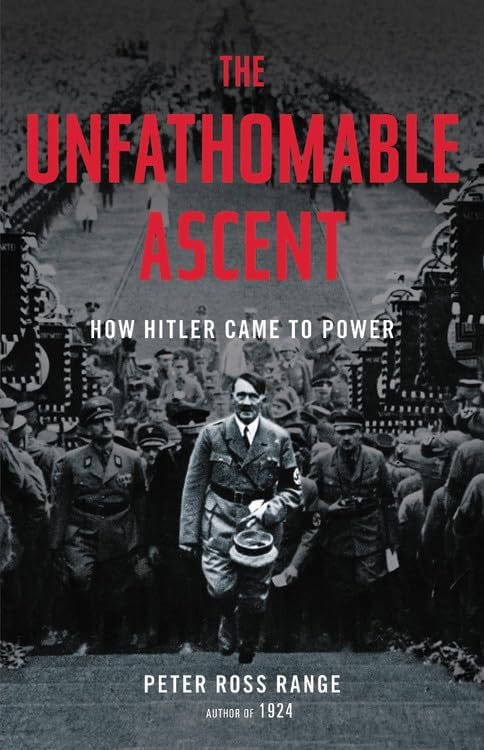
Because of structural impediments, I do not anticipate that Trump will consolidate absolute power with anything like that alacrity, but it will not be for whatever effort he can put forth toward that end or in obliviousness to a stated desire to be dictator “only” on “day one”: because, you know.
As it happened, the November 7 issue of the New York Review of Books offered historian Christopher R. Browning reviewing three books on Adolf Hitler’s rise: titled “Hitler’s Enablers,” the essay considers Takeover: Hitler’s Final Rise to Power, by Timothy W. Ryback; Hitler’s First Hundred Days: When Germans Embraced the Third Reich, by Peter Fritzsche; and The Death of Democracy: Hitler’s Rise to Power and the Downfall of the Weimar Republic, by Benjamin Carter Hett.
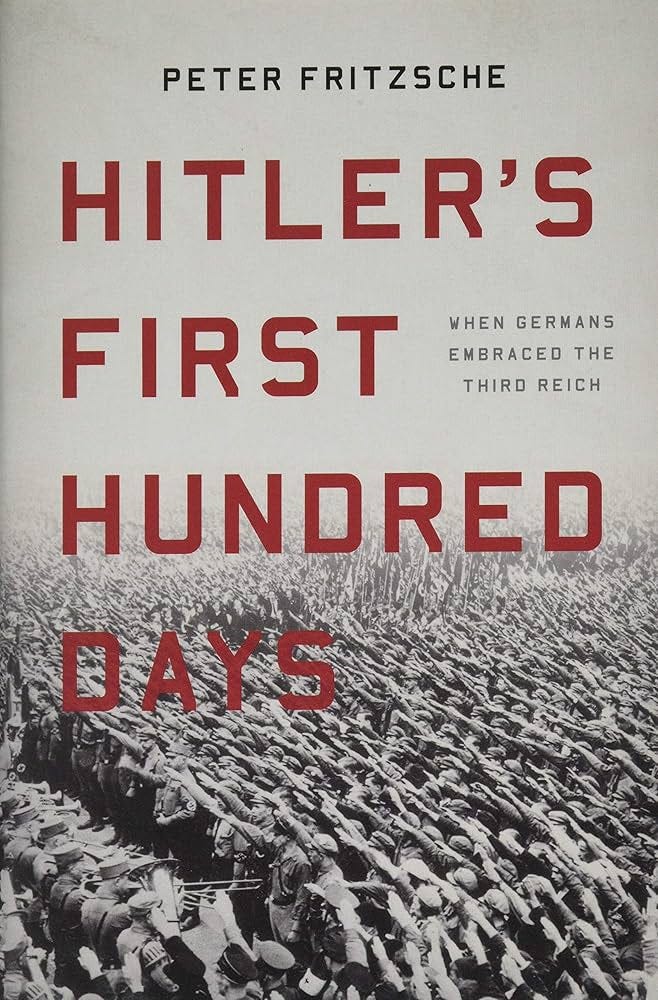
Browning begins:
Historians usually try to maintain two vantage points at the same time. They attempt to perceive and recreate events as contemporaries experienced them. They also utilize the advantages of hindsight and access to a wide array of documentation to try to explain events in a way that contemporaries never could. Sometimes historians also draw upon their knowledge of the past to enhance the understanding of our current situation.
As Americans stand on a second or third precipice of what seems a fall already in progress, we read,
The tragic weight of Hitler’s dictatorship on history has lent a sense of inevitability to his coming to power. How could the origins of a regime that was so catastrophic in its consequences have been so contingent? How could the casual decisions of a few feckless men have had such terrible results?
Has the U.S. not not-enjoyed more than a few feckless men and some women this past decade?
As Goebbels wrote in 1928, “The big joke on democracy is that it gives its mortal enemies the tools to its own destruction.”
Has the U.S. political system and its political culture not seemed to us all these many years now “deadlocked” —that is, dysfunctional, frozen before the critical, fundamental task of supporting the lives of its citizens?
Fritzsche notes that there “was no such thing as majority opinion” in fragmented Germany and that the “political system had checkmated itself.” Thus the fate of the country lay in the hands of a small clique of right-wingers around Hindenburg, who were determined not only to exclude the left (the revolutionary Communists as well as the ardently prodemocratic Social Democrats) but also to “destroy the republic and establish a dictatorship.”
Well, the German people in 1932-33 were tired of it, too.
Whatever the false calculations of Hitler’s partners, his appointment as Weimar’s twenty-third chancellor was felt to be “different” from previous transitions, according to Fritzsche, and the Nazis benefited enormously from the yearning of millions of Germans for “a new start” after years of crisis and deadlock.
After the Reichstag fire of February 27, 1933, “in the palpably unfree elections of March 5, the Nazis won only 44 percent of the popular vote. Their coalition partners garnered another 8 percent, giving the government a thin 52 percent majority.”
Despite the closing grip on power, so quickly, still, 48% of the German people had not voted for Hitler or his allies.
The challenge Fritzsche sets himself is to explain how the Nazi regime managed “to erode” so much of this silenced 48 percent within the next two months. If repression—always cast as counterterror against the Communist threat and necessary to preserve law and order—could neutralize opposition within five weeks, it nevertheless continued unabated thereafter. The new regime needed several more months to obtain willing identification with and consent from a significant majority of Germans.
. . . .
Simultaneously, the “‘48 percent’ who had not voted for Hitler almost entirely disappeared from view” as they increasingly seemed “obsolescent” even to themselves.
Benjamin Carter Hett, in The Death of Democracy, according to Browning, tells us that “in many ways, our time more closely resembles the 1930s than it does the 1990s,” as the Nazis “were fundamentally a protest reaction against globalization.”
Browning summarizes Hett’s account of the German narrative like this:
[Germans] entered World War I in August 1914 experiencing transcendent unity but . . . their defeat in November 1918 was the result of a “stab in the back” perpetrated by Jews, Marxists, and internationalists. The lost war, revolution, unjust peace settlement, economic chaos, and “huge social and technological change” were so intolerable that they led to a rejection of reality by many Germans. And they supported Hitler because he gave “voice to this flight from reality as could no other German politician of his time.” This “hostility to reality translated into contempt for politics” that in turn destroyed the “minimal common ground” that democracy needs to function.
Hett then turns to what he calls the Hitler paradox: “Adolf Hitler lied all the time. Yet he also said clearly what he was doing and what he planned to do.” As his finance minister, Count Lutz Schwerin von Krosigk, observed, “he was so thoroughly untruthful that he could no longer recognize the difference between lies and truth.” But his followers craved “authenticity,” and “facts didn’t matter at all.” For Hitler his message “had to be simple” and “emotional,” not intellectual. And while he was personally close to no one, he had “a remarkable intuition for the thoughts, hopes, fears, and needs of other people.” Among other traits of Hitler, Hett includes insecurity, intolerance of criticism, bombastic claims about his own achievements, and scorn for intellectuals and experts. Thus without ever mentioning Donald Trump and MAGA, Hett clearly intends to draw parallels between Hitler and the Nazis on the one hand and the current American situation on the other.
As the disappearance of the “48 percent” and the following, right out of 2024 American pollster demographics, make clear, “Hitler” — like “Trump” — was not inevitable.
Hett notes how dramatically the center of political gravity in Germany shifted between the presidential elections of 1925 and 1932: “The patterns of support in the 1925 election had been completely reversed…. The best statistical predictor of a vote for Hitler in 1932 was a vote for Hindenburg in 1925.” I think it should be noted that in addition to taking the bulk of the Protestant middle-class vote that previously went to the DDP, DVP, and DVNP, the Nazis were overwhelmingly successful in capturing first-time voters, especially youth, and were also disproportionately successful among women voters.⁸
Like Ryback and Fritzsche, Hett places ultimate responsibility for Hitler’s ascent on German conservatives, who disdained democracy:
The crisis and the deadlock of 1932 and early 1933, to which Hitler appeared as the only solution, was manufactured by a political right wing that wanted to exclude more than half the population from political representation…. To this end, a succession of conservative politicians…courted the Nazis as the only way to retain power on terms congenial to them. Hitler’s regime was the result.
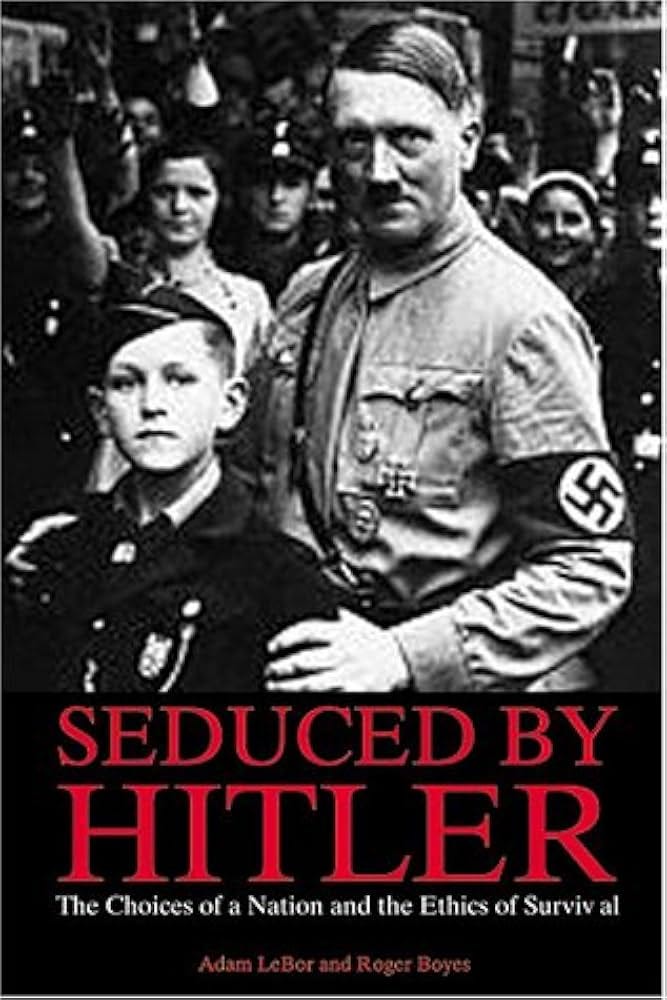
Trump and the Trumpists have been showing and telling us what he is and what he wants to become all along. The newest moon you ever saw has been growing in the darkest American political night you never imagined, filling the sky, and too many fool themselves it’s just a phase we’re going through.
How long is the phase of your life, the lives of those you love?
Before it is too late, do not be quiet — do not seek, simply, to go on, to get by, merely to survive.
Do not go gentle into that good night.
Rage, rage against the dying of the democratic light.
AJA

Thank you, Jay. I, too, am convinced that America is moving towards a head-on collision with reality, a crash-and-burn disaster. My plan to move to France was realized; what wasn't considered was the strong pull our grandchildren would have on my wife. We're back in Trump Country, Umatilla County, Oregon. Helping our daughter open a business, enrolling grandchildren in martial arts, and seeing our daughter win 100% custody were the rewards for our move back from France. But. The collapse of America is like that dust storm drought driving the Joad family in Steinbeck's The Grapes of Wrath. Where does this Ramser family go when it hits Pendleton? A quick escape could be to Albania. The process of applying for a D-7 visa to Portugal takes months in planning. So far, I am the only one in our group who sees the collapse coming. My plan to move to Europe failed because I could not read how deep a maternal instinct is. I wonder if others are experiencing a similar pickle?
Those news pieces from 1933 are devastating.
Thank you, Jay, for laying it out so clearly.